
The Problem
The modern landscape for listening to music is rich with peaks and valleys. This guide is intended to help you navigate it. Starting from an artist’s master recording, how much of that sound actually makes it to you—and how much do you lose along the way? We intend to answer that question. But first we need a way to quantify it. Let’s introduce PEAQ.
What is PEAQ?
PEAQ (Perceptual Evaluation of Audio Quality) is a standardized objective metric defined in ITU-R BS.1387. It compares a test signal with a reference signal and predicts what listeners would report on a difference grade scale. The headline output most engineers reach for is the Objective Difference Grade (ODG).
| ODG (approx.) | Everyday meaning |
|---|---|
| 0.0 | Imperceptible difference from the reference |
| −1.0 | Perceptible, usually not annoying |
| −2.0 | Slightly annoying impairment |
| −3.0 | Annoying |
| −4.0 | Very annoying |
The reason that I chose PEAQ over something like data loss is that compression algorithms are pretty fantastic about reducing the size of the data without a loss in quality. Some of that has to do with the limitations of the human ear and frequencies we can’t even hear, but some of it is psychoacoustics and how the brain processes sound. We know enough about what we won’t perceive anyway, so we drop that bit.
Physical media
With our new unit of measure, let’s look at physical media.
| Medium | Typical ODG vs high-res digital ref | What swings the number hardest |
|---|---|---|
| Master tape (studio reproduction) | −0.1 to −0.6 | Tape speed, head wear, print-through, noise reduction |
| CD (Red Book playback) | 0.0 to −0.2 | Mastering chain, jitter mythology vs real boundary problems, rip accuracy |
| Vinyl | −0.4 to −2.0 | Pressing, tracing, inner groove, surface |
| Cassette | −1.0 to −3.0 | Tape type (Fe/Metal), Dolby calibration, azimuth, wow/flutter |
| 8-track | −2.5 to −3.8 | Head alignment, pad pressure, splice noise, scrape flutter |
Insight: CDs are underrated
CDs are king of accurate reproduction in physical media because they add zero noise. They also have better dynamics and no channel bleed. If you want high accuracy media, you want a CD. That isn’t to diminish the cycles of popularity with older media, but you have to acknowledge the baseline noise added by your media of choice.
Digital files: lossless and common lossy encoders
What about digital files?
| Format | Class | Typical stereo music preset | ODG vs same lossless ref | Notes |
|---|---|---|---|---|
| WAV / AIFF / FLAC / ALAC / WavPack (lossless) | Lossless | any 44.1 or 48 kHz master | ≈ 0.0 | Identity path when reference = that master’s PCM before encode (BS.1387); WavPack hybrid adds a separate correction sidecar—still lossless when used as intended |
| AAC | Lossy | ~256 kb/s class (e.g. TV / store “high”) | −0.2 to −0.8 | PEAQ is widely used for AAC family planning; see Ulovec & Smutny 2018 for broadcast AAC/MP2 vs bitrate |
| AAC | Lossy | ~128 kb/s class | −1.0 to −2.0 | Same caveat: codec profile (LC vs HE) dominates as much as nominal bitrate |
| MP3 | Lossy | ~320 kb/s (CBR or V0) | −0.2 to −0.8 | Same paper applies PEAQ to MPEG coders in a defined test harness—not every LAME build |
| MP3 | Lossy | ~128 kb/s | −1.0 to −2.5 | Pre-echo and HF roughness usually show first |
| Vorbis | Lossy | -q / bitrate ladder on 44.1 kHz | −0.4 to −2.0 | Container name matters less than encoder preset |
| Opus | Lossy | 48 kHz path (typical) | −0.5 to −2.5 | Speech-optimized modes vs music change the error spectrum; Duong & Springer 2025 surveys codecs with PEAQ-style scores |
Insight: Lossless is an amazing digital copy
If you are buying digital media, make sure it’s lossless—why pay for a degraded format? If you are backing up your music collection, back up to lossless.
Streaming and radio
Now let’s look at on-demand streaming and over-the-air radio—terrestrial and satellite—before the signal reaches your DAC or headphone output.
| Service | Tier (illustrative) | Codec / format | Typical bitrate or resolution | Typical ODG vs lossless ref | Notes |
|---|---|---|---|---|---|
| Tidal | HiFi (lossless) | FLAC | CD-quality and hi-res where offered | ~0.0 | Hi-Res catalog subset; hardware limits apply |
| Apple Music | Lossless | ALAC | 16/44.1–24/192 (title-dependent) | ~0.0 | ODG ≈ 0 only when the path stays lossless to the DAC—not over typical Bluetooth |
| Amazon Music | HD | FLAC (lossless) | CD-quality (~16/44.1) | ~0.0 | Requires subscription plan and device support |
| Amazon Music | Ultra HD | FLAC (lossless) | up to 24/192 (title-dependent) | ~0.0 | Not all titles; playback may downsample silently |
| Spotify | Lossless (Premium; region / app-dependent) | FLAC | up to ~24-bit / 44.1 kHz (Spotify — Audio quality) | ~0.0 | Distinct from the Vorbis path below |
| Apple Music | High Quality (lossy default in many clients) | AAC | ~256 kb/s | −0.2 to −0.8 | Lossless / Hi-Res Lossless tiers exist when enabled |
| Spotify | Low through Very High (lossy ladder) | OGG Vorbis | ~24 kb/s (Low / data saver) → ~320 kb/s (Very High) | −0.3 to −3.5 (setting-dependent) | High ~160, Normal ~96; Free vs Premium caps differ by platform—see Audio quality |
| Amazon Music | Standard / Best Available (lossy path) | Often AAC-class in mobile clients | ~256 kb/s (order-of-magnitude) | −0.3 to −2.0 | Wording in-app (SD / HD / Ultra HD) differs by market |
| Tidal | Normal (lossy) | AAC (typical mobile / web ladder) | ~96–320 kb/s class | −0.4 to −2.0 | Exact labels (Max / HiFi) shift with rebranding |
| FM radio (terrestrial analog) | Stereo, listenable RF | Analog FM + MPX decode in tuner | ~50 Hz–15 kHz class (service & tuner dependent) | −0.4 to −2.0 | Multipath, pilot noise, preemphasis; HD Radio digital sidebands (where supported) replace part of the analog budget—still lossy vs studio master |
| AM radio (terrestrial analog) | Typical regional broadcast | Amplitude modulation | ~4.5–7.5 kHz audio bandwidth class | −1.2 to −3.5 | Narrow bandwidth, electrical noise, nighttime skywave; music never the format’s strength |
| SiriusXM | Music channels (illustrative) | Satellite / IP delivery, AAC-class codec (proprietary chain) | Order-of ~32–~256 kb/s class by era and channel | −0.6 to −2.5 | Talk / traffic channels often run lower music rates; 360L / app vs legacy radio HW can change the decode path |
Insight: Normalization is the sneaky second algorithm
This isn’t all that your streaming service is doing. They typically have options to “normalize” sound. Read up on what your service is doing or try the settings yourself to see what sounds best.
Computers and phones: built-in DACs
DAC stands for digital-to-analog converter.
After the stream is decoded, something still has to turn PCM into voltage. On laptops and phones that is usually a combo codec (DAC + headphone amp) and, on computers, often a shared mixer, volume DSP, and driver resampler before the chip ever sees audio.
| Platform | What this row assumes | Typical ODG vs lab USB DAC | Why it lands there |
|---|---|---|---|
| macOS | Recent Apple laptop 3.5 mm combo jack, or Mac desktop line-out class | 0.0 to −0.5 | Predictable CoreAudio routing; often clean enough that the codec chain upstream matters more |
| iOS | iPad (or rare legacy hardware) with onboard 3.5 mm—not Apple adapters; iPhone → Connectors | 0.0 to −0.4 | Apple’s jack implementations usually measure well; most current iPhones skip this row |
| Windows | Mass-market Windows 11 laptop 3.5 mm output | −0.2 to −1.0 | Vendor DSP, “smart audio,” and Realtek stacks; ground and GPU leakage vary wildly by SKU |
| Android | Mid-range handset with built-in 3.5 mm (exclude USB-C audio gadgets; those live under Connectors) | −0.3 to −1.2 | Highest variance: tuned flagships beat this band; cheap carrier phones often worse |
Insight: Know your DAC
If you already own devices, look up how your DAC measures. If you care about music playback and you’re shopping for something new, you can read reviews on which devices to avoid based on poor audio performance.
Connectors
But wait there is more. We still have potentially more hurdles before we have sound!
| Path | Dominant impairment | Typical ODG band | Honest caveat |
|---|---|---|---|
| USB Audio Class to decent DAC | Often limited by Windows mixer / Android resampling unless exclusive | 0.0 to −0.4 | Policy beats cable mythology |
| Wi-Fi streaming to a renderer (AirPlay, Chromecast / Cast, DLNA, Roon Ready endpoint, vendor hi-fi bridges) | SDK resampling, buffer underruns, receiver DSP, proprietary wrappers that re-encode | 0.0 to −0.8 vs local lossless when the path is documented bit-transparent | “ On Wi-Fi ” ≠ automatic lossless—check Connect/AirPlay mode and what the box actually decodes |
| 3.5 mm analog (phone or DAP headphone jack) | DAC + amp noise floor, IMD at high load | 0.0 to −0.6 | Phone jacks vary wildly; volume matters |
| USB-C digital headset / USB-C → 3.5 dongle | Budget DAC filter images, USB packet jitter debates, power noise | 0.0 to −0.8 | Many dongles are fine; some are squeaky on efficient IEMs |
| Bluetooth Classic audio | Mandatory codec (SBC baseline; AAC/aptX/LC3/LDAC variants) | −0.5 to −2.5 vs wired phone reference | Second codec after streaming—watch the cascade |
Insight: The connector is rarely the villain—but Bluetooth often is
The convenience of Bluetooth comes at a serious audio cost. If your have ability to send sound over usb / usbc vs bluetooth you can prevent how much noise is introduced.
True wireless earbuds
Let’s look at the oh so popular ear buds.
| Earbuds (class / generation) | Typical Bluetooth path | Typical ODG vs quiet-room wired reference | Notes |
|---|---|---|---|
| Sony WF-1000XM5 | SBC / AAC / LDAC (Classic); LC3 (LE Audio) per Sony help | −0.35 to −1.0 | No aptX family on Sony’s published codec list for this model; LDAC needs “ Prioritize Sound Quality ” |
| Samsung Galaxy Buds3 Pro (or Buds2 Pro) | Samsung Seamless Codec (SSC) on Galaxy phones; AAC / SBC elsewhere | −0.4 to −1.1 | Samsung stack unlocks the widest codec here; other phones fall back to AAC |
| Apple AirPods Pro (2nd gen) | AAC from iPhone | −0.4 to −1.0 | Strong ANC + H2 DSP; seal and Personalized Spatial blur coupler predictions |
| Google Pixel Buds Pro | AAC / SBC (Google/review sources do not list aptX on original Pro); newer revisions may differ | −0.5 to −1.1 | Codec ceiling is modest versus LDAC earbuds on some Android phones |
| Nothing Ear (2) — extra budget flagship | AAC / SBC typical | −0.6 to −1.3 | Useful contrast: price tiers chase codec diversity before driver quality |
| Apple AirPods (open, non-Pro) | AAC | −0.6 to −1.4 | Open fit = no isolation; “ hi-fi ” loses to coffee shop noise before ODG matters |
Insight: Earbuds are a Bluetooth chapter wearing a jewelry case
Sony WF-1000XM5 are the rock stars of wireless earbuds.
After the amp: rooms, speakers, and vehicles
PEAQ / BS.1387 compares a test signal to a reference under conditions the model was built for—typically codec or electrical paths before the listening room takes over. Put another way, it’s not intended to measure how your environment affects what you are hearing. You just need to know that it does.
Conclusions
What do we do with all this? It’s clear that there are many options for a good listening experience. If you’re not happy with your current setup, hopefully you got some ideas on how to improve it.
References
Definitions (best primary sources)
- ITU-R BS.1387 — Method for objective measurements of perceived audio quality (ITU). Defines PEAQ, MOVs, and Objective Difference Grade (ODG) mapped from perceptual features of reference vs test signals.
- ITU-R BS.1116 — Methods for subjective assessment of small impairments (ITU). Subjective Difference Grade (SDG) scale PEAQ’s mapping is trained to predict (see Delgado & Herre 2022).
Secondary / explainer
- Wikipedia — Perceptual Evaluation of Audio Quality — compact ODG ⇄ impairment wording (verify against your edition of BS.1387).
PEAQ applied to coders and bitrates (peer-reviewed / preprint)
- K. Ulovec & M. Smutny, “Perceived Audio Quality Analysis in Digital Audio Broadcasting Plus System Based on PEAQ,” Radioengineering 27(1), 2018 (PDF). PEAQ on AAC (multiple profiles) and MP2 vs bitrate, mono/stereo, speech/music—useful precedent for how ODG behaves in a fixed lab setup (DAB+ oriented).
- P. M. Delgado & J. Herre, “Can we still use PEAQ? A Performance Analysis of the ITU Standard for the Objective Assessment of Perceived Audio Quality,” arXiv:2212.01467, 2022 (arXiv). When ODG is reliable, when it lags modern codecs, and how the ANN mapping relates to listening-test data.
- T. T. Duong & J. P. Springer, “Evaluation of Audio Compression Codecs,” arXiv:2511.11527, 2025 (arXiv). Survey using PEAQ and variants across traditional and ML codecs.
Streaming product facts (not PEAQ)
- Spotify — Audio quality.
- Apple — About lossless audio in Apple Music.
Hero image
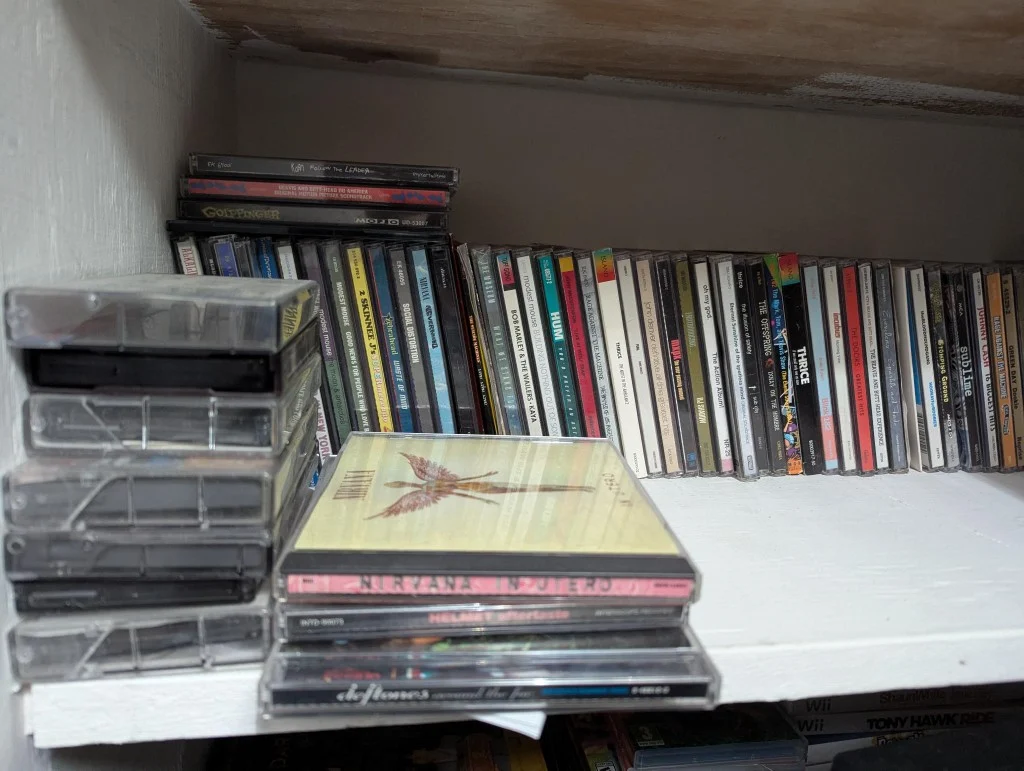
- Author photograph (foreground CD stack, spine row, cassettes on a white shelf), local WebP
/images/modern-music-listeners-guide-hero.webp(1024×771) for the post hero and Open Graph.
Illustrative bands in the physical media, streaming/radio, DAC, connector, and earbud tables are not taken from a single published PEAQ matrix—run your captures (same reference, time alignment, validated PEAQ build) if you want citeable row values.